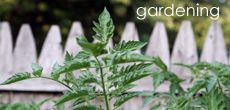
The swiss chard is still thriving...
 ...while the tomatoes are slowly dying. 36 degrees this morning. Cold.
 The swiss chard is still thriving......while the tomatoes are slowly dying. 36 degrees this morning. Cold.
 The squirrel strikes again...stealing a ripe tomato, taking a bite, and displaying it on a fence post for me to see.
 The damage was kind of gross. (It's rainy today, by the way, so that's not all squirrel slobber.)
 I also heard a loud noise on the back steps and looked out to see this...the last of my giant zinnias toppled over. Although it's rainy today, it's certainly not very windy or stormy...I think the squirrel did it under the guise of bad weather. At any rate, they are completely severed, so that's the last of them.
 I still have my thumbelina zinnias although as you can see they have almost run their course.
 The wrath of the vicious squirrel continues...this weekend he took out his anger on my little Travelocity garden gnome. The chard and lettuce seeds took a hit as well.
 On the bright side, look at these beautiful fall tomatoes! Okay, I posed them outside in the grass for good light and color, but let me tell you a secret...I picked them when they were still green and ripened them in a brown paper grocery sack to keep them safe from the squirrels! Tomatoes ripened on the vine have a slightly better flavor but these are still delicious, and by the sad remains of a few I let turn red on the vine, I did the right thing. I have another bag ripening now and should have a few more before the frost hits.
 Welcome, fall. Ohio has a beautiful autumn season, the only downfall being that it gets cold much too early for me (For example, today's high is 54 degrees, and it's still September! This is unheard of in the South, where I heard rumors of highs in the 90s this week.). My fall garden is not so impressive, but rather is primarily only an extension of the spring/summer garden. However, being that last year at this time I had just moved here and had no fall garden at all, I'm going to call this one a success.
 As you can see, there is a lot that needs to be harvested (of course I would like it better if I wouldn't let it grow so large and use the baby leaves instead). Next to that you'll see the cabbage, which I never picked. I kind of left it there for the caterpillars. Sigh. It's just that after fighting with them over whose property these heads of cabbage were day after day for so long, I finally surrendered it to the squishy green beasts. It's riddled with holes and doesn't look appetizing, so I think I'll just let it be this year.
 The tomatoes are still flowering! When I first heard of fall tomatoes (last year), I was taken back because in Arkansas, the tomato plants more or less shrivel up and die by the middle of August! Although the harvests haven't been as large as they were in September, between the 10 tomato plants, there are around 40-50 large green tomatoes present at any given time, and lots of tiny cherry and pear tomatoes. I've been picking the green ones as soon as they show a hint of pink and ripening them in brown paper sacks so that the squirrels can't get them. The vicious, conniving squirrels.
 The fall lettuce has been pounced on and dug up a few times by those squirrels, but a few seedlings have managed to make it this far. I'm hoping for a nice lettuce crop soon, but we'll see. I'll probably cover this bed with plastic when it gets colder. We still have a few weeks until the first frost.
 The fall cilantro crop is doing well. I love having fresh cilantro in my backyard...it's probably my favorite herb!
 The fall peas are making their way up the trellis slowly but surely. My zone was just out of the range for growing fall peas, so I'll try covering them when it gets colder...I already had seeds and I just love peas so much that I had to try.
 The zinnias are still going strong, although next year I think I'll plant ten times as many! I'm also planning to put some tulip bulbs in the ground this weekend for a fun surprise next spring.
 Exhibit A: My back steps. I keep a lot of potted plants here so that I don't have to move them when my landlord comes to do yard work. The squirrel chooses to knock one over about two times per week, leaving a huge mess and usually injuring the plant. One of the plants I found face down in the yard, and others strewn about the steps. I also have a potted strawberry root ball that I have been waiting to see signs of life from, and every time it grows a leaf or two, the squirrel is sure to come by and rip them off (he follows this up by using the strawberry container as his personal litterbox). The squirrel also knows that if I've done any work back there, i.e. cleaned up last week's mess, it's prime time to come mess something up.
 This poor succulent will recover, I hope, but I found it one day in pieces all over the grass below the steps, with squirrel teeth marks in many of the leaves. Luckily succulents can grow new roots from cuttings, but let's just say that I had one succulent in this planter before and now I have about seven.
 Exhibit B: The fall peas and lettuce. The squirrel loves to dig these up, ensuring that I will not have good crops of either this season. I don't have the time to replant the seeds, since the frost will be here soon. The lettuce has taken it especially hard. I did three lettuce plantings, sowing more seeds each time the squirrel paid a visit, but he's still coming back to dig up the now-tiny seedlings.
 Exhibit C: He takes a few bites of an eggplant (shown here: gretel eggplant) or tomato, then leaves the rest to rot where I can see it. The gnome is not such a good garden guard, as you can see.
 I am all about keepsakes and mementos, so when I got the idea to draw this today, I didn't waste any time before getting started. It features the specific varieties of plants in this year's garden in an adorable grid of doodles! I had so much fun drawing it and I think it would be fun to do one each year to remember what we grew. I'm going to make a print of it on nice paper and hang it up.
 Planning ahead for the garden is both exciting and overwhelming. I spend hours reading seed catalogs and gardening books during the winter months. This leads to getting caught up in picking "the perfect" seed varieties and lost in tables of planting dates and row spacings. If you've ever felt a little panicked while trying to plan out your garden, take comfort in the fact that you are not alone. But it gets easier, friends. I'm not an expert but I learn new things about plants and gardening every day, and after keeping a garden for a few seasons, the planning part is so much easier. Here are a few tips I have for staying on track and not letting your fears of "messing something up" get in the way of actually getting your garden in the ground:
 One aspect of planning ahead I am adding to my repertoire this summer is seed saving! There is something special about connecting your gardens to one another year after year, plus if done correctly, it can save you some money. Since this is my first year to save seeds, I'm not expecting miracles and I'm okay with the fact that I might end up having to purchase a type of seed that I attempted to save. But I'm all for the learning process and hope to have some success with these seeds next spring! I read the seed-saving section of my Rodale's organic gardening encyclopedia (a wonderful source of information) and got to work this weekend saving lettuce seeds, coriander, and peas.
 Lettuce. When it gets too warm or lettuce has reached maturity, it will bolt, sending a long stalk up and eventually flowering. Lettuce flowers are self-pollinating, so after most of the flowers had opened, I cut off the stalk and kept it in a vase of water until the remained opened and they dried out, to prevent the dandelion-like flower remains from blowing away. When it had completely dried, I carefully picked off each white "fluff," which had about a dozen seeds attached to the end. At first I saved some of the white fluffy parts but eventually I was proficient enough to remove those and save just the seeds:
 Next up, coriander, the seeds of the cilantro plant. Coriander is used as a spice, so you could save the seeds for that purpose or to plant. This is what the seeds look like on the plant before they dry out:
 Once they turn brown, they are easily removed from the plant:
 Finally, peas. When your pea crop is nearing the end, leave some pods on the vine to dry. When they are completely dried out (they will be brown and will not be holding any moisture), remove and shell the pods, to reveal wrinkly peas inside.
 My Rodale's reading suggested saving the seeds in envelopes and keeping them in the refrigerator, since they do best in low humidity. You can also store the envelopes in a cool, dry place as an alternative.
 This is the fourth new recipe I've tried this week, and I still have a few days left. You might be rolling your eyes and asking, "Does she find recipes anywhere else!?" when I say, it's from Smitten Kitchen. The answer to that would be...it's where I look first, and often I have no reason to look elsewhere. It's just that, the Smitten Kitchen recipes seem to coincide with the groceries I already have, while other recipe sources seem to insist on a trip to the store just for one recipe.
 No matter. Yesterday, I decided to make creamed chard and onions and serve it over spaghetti. The original recipe called for actual cream. I used plain soy milk (unsweetened would have been better) and it worked out fine. The good news is that I was able to find a use for some of the swiss chard in the garden (my plan when I sought out a recipe to make), which is quickly approaching the size of elephant ears. It was so easy to grow, and it's beautiful, and everyone tells me how versatile it is, but help, I just don't know what to do with it! I throw a few leaves in stir fries here and there, but other than that, I'm lost.
 Here is everything cooking on my tiny stove. One pot was to soften the chard. A skillet to make the roux (butter + flour--I used Earth Balance) and toast the onions and garlic. And finally, a pot of spaghetti. The dish was simple and delicious.
 Finally, I leave you with this. These are all the green tomatoes I had to cut off of the tomato plants last weekend because of damage to a few branches. I put them all in a brown paper sack, closed it up, and forgot about it for a few days. One has turned red and a few more are on their way (some might be too under ripe to ever turn red)! The ethylene gas that they naturally give off helps them turn red faster when trapped in the bag.
 Three days ago among the zinnias I noticed a praying mantis.
 She's been there every day since.
 Twenty-six zinnias and counting,
 Guarded by one watchful insect.

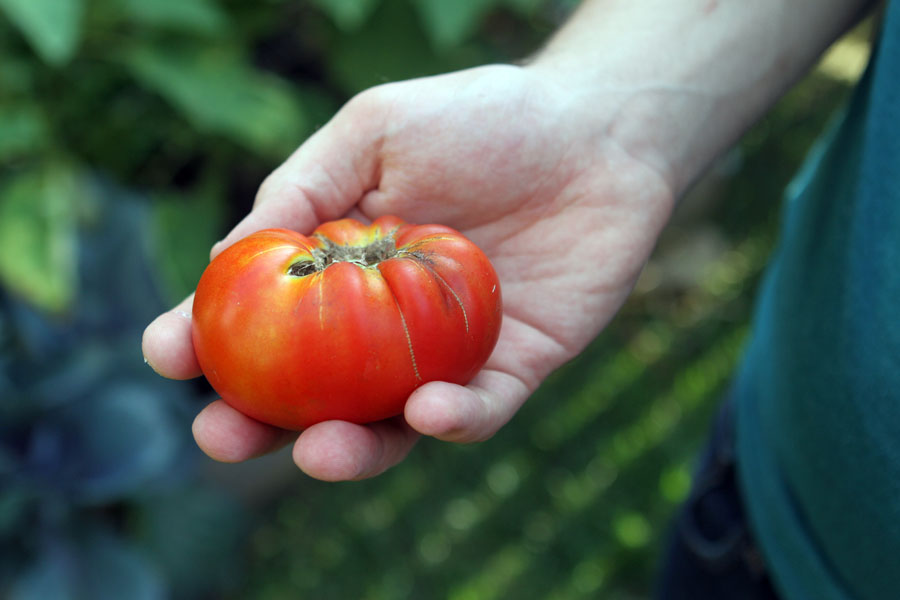 Seven tomatoes ripening in various shades of red--
 Of course this one would be the first to finish,
 Because I wanted to photograph the occasion
 Of the first big tomato of summer.
 My tastebuds would not discriminate, so neither would I,
 There in my fridge sat a large bowl full of green tomatoes, mostly pear, a few cherry. You know, the green tomatoes I wouldn't stop talking about last week. They called out to me every time I opened the refrigerator door, leading to feelings of guilt over wasting food I had grown with my own two hands. I made two batches of green salsa and still had leftovers. Always eager to try new recipes/kitchen skills, I decided to pickle them. I wasn't completely new to pickling. Last year, we made two jars of pickled banana pepper rings (with so many surplus banana peppers from the garden, we thought the jar number was going to be closer to seven or eight, but so go pickles). Then we promptly left them in Arkansas (accidentally) before they were ready to eat (but truth be told, they were a little on the mushy side because I wasn't sure when to stop boiling them during the pickle-making process).
 First, I sterilized my jar, then tossed in all the seasonings. I did not have any hot peppers, so I altered that part of the recipe and substituted red pepper flakes. I also used two cloves of garlic, a few pinches of dill, four peppercorns, and 1/4 tsp homemade pickling spice.
 The thing I liked about this process is that I did not have to boil the tomatoes. Like I said before, last year that's where I messed up the banana peppers. You want your pickles to be crispy. At this point, I added my thoroughly washed tomatoes to the jar on top of the spices. At the same time, I was boiling water, vinegar (5% acidity), and salt. I could not locate any pickling salt so I used Kosher. Don't use iodized salt or you will have some ugly pickles (still edible though).
 After the vinegar mixture comes to a rolling boil, I poured it over the tomatoes. My recipe suggested adding 1 tsp olive oil to each jar for added flavor, so I did so. I left half an inch of room at the top of the jar.
 Then I topped off my jar with a sterilized lid and let it cool on the counter for two hours.
  Voila! Now I wait two weeks, then here's hoping I have some tasty pickles.
 In Italian, the word for eggplant, melanzana, means literally, "toxic apple." A member of the nightshade family, it was once believed to have caused insanity.
 In Italy, I discovered how much I truly love eggplant. Luckily it is no longer attributed to madness. My friend Casey and I started an eggplant club. We were the only members. No one could love eggplant as much as we did, we joked. We had it at every meal!
 Last year I had one Japanese eggplant in a container. It produced a single fruit late in the summer, which withered and died before reaching maturity. I questioned whether I should try again this year, but since I'm in a different zone now, I went ahead with it. I got two plants: a black beauty and a gretel, and planted them in the raised bed rather than a container. They are doing beautifully and producing eggplants, dare I say, like mad. We harvested the first one yesterday.
 It was so beautiful and perfect, that I couldn't stop admiring it. It amazes me that I had so much trouble last year, and that this time around it has been so easy.
 We put it on a homemade pizza, one of my favorite uses of fresh summer produce.